Bar with background
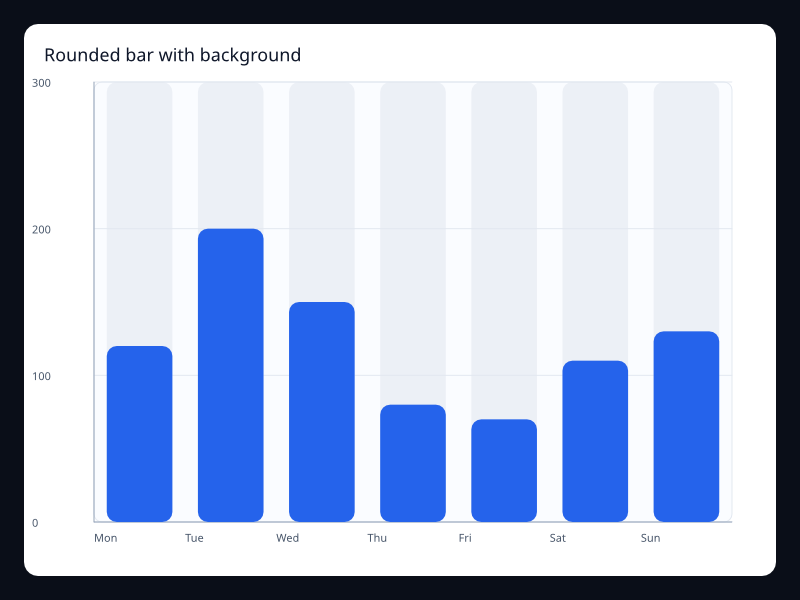
Rounded bars drawn over a full-range background track. Use it for progress-like category comparisons where the maximum should remain visible. The screenshot is captured from the native Fission chart gallery.
What the chart is for
Bar with background belongs to the Cartesian family. Its job is to make this data shape readable: BarSeries values plus background and border-radius styling. In a production interface, choose this chart when the visual form makes the user's question faster to answer than a table or a simpler chart would.
Avoid it when the visual form makes the user estimate more than necessary; choose the simplest chart that answers the product question.
Data model
BarSeries values plus background and border-radius styling. Keep the data close to the type that describes it. Fission Charts is typed Rust, so a line uses LineSeries, a calendar heatmap uses CalendarHeatmapSeries, and chart components such as zoom, marks, and graphics are explicit fields on Chart rather than hidden string configuration.
Rust API
| Field | Type | Notes |
|---|---|---|
title | &str | Names the chart for the screen, accessibility tree, and test output. |
x_axis / y_axis | Axis | Vertical bars use category x/value y; horizontal bars use value x/category y. |
series | BarSeries | Holds values plus stack, orientation, radius, background, and color styling. |
width / height | f32 | Optional fixed size; omit them when the chart should flex inside Fission layout. |
Example
use fission_charts::{Axis, BarSeries, Chart};
use fission_core::op::Color;

let chart = Chart::new()
    .title("Rounded bar with background")
    .x_axis(Axis::category(vec!["Mon", "Tue", "Wed", "Thu", "Fri", "Sat", "Sun"]))
    .y_axis(Axis::value().max(260.0))
    .series(vec![BarSeries::new("Traffic")
        .border_radius(10.0)
        .background(Color { r: 226, g: 232, b: 240, a: 150 })
        .data(vec![120.0, 200.0, 150.0, 80.0, 70.0, 110.0, 130.0])
        .into()]);
Interaction and animation
Charts can emit typed ChartInteractionEvent values when interaction is enabled. Handle those events in a reducer when the app needs hover, press, release, scroll, selection, or brush behavior. ChartAnimation stores duration, delay, stagger, easing, and reduced-motion behavior as deterministic chart data, so animation timing can be tested instead of being hidden in ad-hoc timers.
Testing guidance
For this chart, test the data mapping first, then test lowering, then capture a live screenshot when visual output changes. The screenshot for this page is refreshed with npm run charts:generate from the website package.
Tags: bar, background.